Plantes stimulant la testostérone : 7 ingrédients soutenus par la recherche
La baisse des niveaux de testostérone touche des millions d'hommes avec l'âge, se manifestant souvent par une diminution de l'énergie, une réduction de la masse musculaire et une acuité cognitive altérée. Bien que le traitement substitutif à la testostérone (TRT) reste une intervention médicale, de nombreuses personnes soucieuses de leur santé recherchent des alternatives botaniques qui soutiennent la production hormonale endogène du corps sans recourir à des interventions synthétiques. Comprendre quelles plantes booster de testostérone possèdent une validation clinique permet de distinguer la supplémentation fondée sur des preuves de l'hyperbole marketing.
L'exploration suivante examine sept composés phytochimiques démontrant des effets mesurables sur les paramètres de testostérone, les indicateurs de libido et les biomarqueurs de performance dans des recherches évaluées par des pairs. Ces plantes agissent par le biais de mécanismes variés — en modulant l'axe hypothalamo-hypophyso-gonadique, en réduisant la suppression induite par le cortisol ou en améliorant la signalisation de l'hormone lutéinisante.
Qu'est-ce qui rend une plante booster de testostérone scientifiquement valide ?
Établir l'efficacité d'une plante nécessite plus que la simple tradition anecdotique. Une supplémentation rigoureuse exige des essais contrôlés randomisés mesurant les concentrations de testostérone sérique, les pourcentages de testostérone libre ou les marqueurs androgéniques en aval comme les taux de synthèse des protéines musculaires. L'étalon-or implique des protocoles en double aveugle avec comparateurs placebo, menés de préférence dans plusieurs institutions de recherche.
La biodisponibilité constitue une autre considération critique. De nombreux composés présentent une activité prometteuse in vitro mais montrent une faible absorption intestinale ou un métabolisme hépatique rapide. Les méthodes d'extraction, les matrices porteuses et les constituants actifs standardisés influencent considérablement les résultats réels. La vérification par des tiers via des laboratoires indépendants garantit que les allégations sur les étiquettes correspondent aux concentrations phytochimiques réelles, éliminant ainsi l'incertitude inhérente aux mélanges exclusifs.
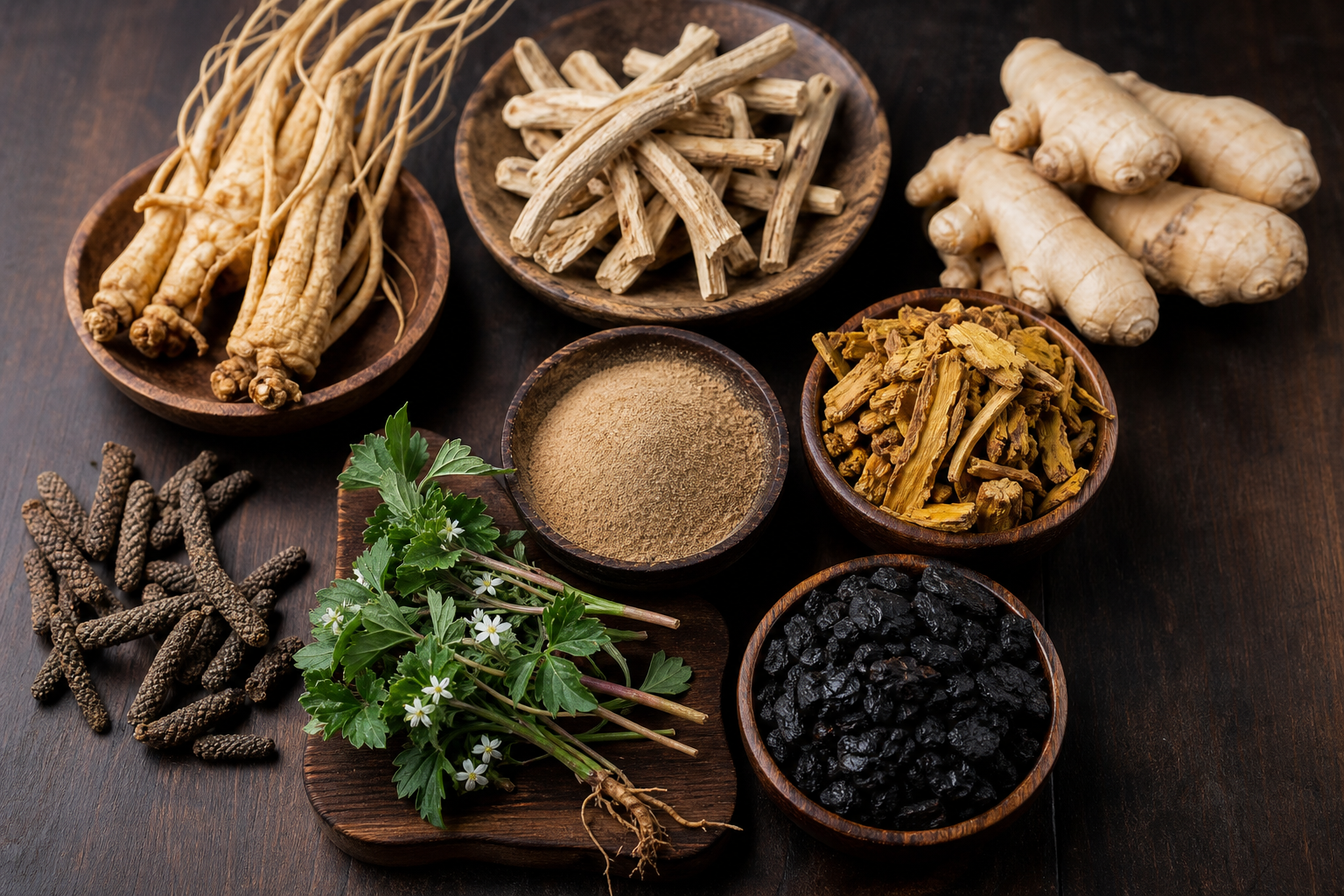
Les sept plantes booster de testostérone validées par la recherche
Shilajit : La résine himalayenne à la puissance de l'acide fulvique
Cet exsudat riche en minéraux provenant de formations rocheuses de haute altitude contient de l'acide fulvique comme composant bioactif principal. Une étude contrôlée par placebo de 2015 publiée dans Andrologia a démontré que les hommes recevant 250 mg de Shilajit purifié deux fois par jour ont connu une élévation significative de la testostérone totale (augmentation de 20,45 %) et de la testostérone libre (augmentation de 19,14 %) après 90 jours consécutifs.
Le mécanisme d'action implique l'optimisation mitochondriale. L'acide fulvique fonctionne comme un transporteur d'électrons dans la production d'énergie cellulaire, tout en soutenant l'activité de la CoQ10. Une efficacité mitochondriale accrue se traduit par une meilleure fonction des cellules de Leydig — les structures testiculaires responsables de la biosynthèse de la testostérone. Les athlètes cherchant à améliorer leurs performances naturelles incorporent fréquemment cette substance adaptogène pour le soutien hormonal et l'amplification de l'endurance.
Tongkat Ali : Eurycoma Longifolia d'Asie du Sud-Est
La médecine traditionnelle malaise utilise la racine de Tongkat Ali depuis des siècles, mais la recherche contemporaine valide ses propriétés modulatrices de la testostérone. Une étude de 2012 dans le Journal of the International Society of Sports Nutrition a examiné des hommes physiquement actifs supplémentés avec 100 mg d'extrait standardisé par jour. Les résultats ont montré que les concentrations de testostérone ont augmenté de 37 % tandis que les niveaux de cortisol ont diminué de 16 %.
Le mécanisme à double action s'avère particulièrement précieux pour les hommes vieillissants. Le stress chronique élève le cortisol, qui antagonise la production de testostérone par inhibition enzymatique compétitive. Les quassinoïdes bioactifs du Tongkat Ali suppriment simultanément le cortisol tout en stimulant la libération de l'hormone lutéinisante, créant un environnement hormonal favorable. La standardisation du dosage est capitale — recherchez des extraits spécifiant la teneur en eurycomanone plutôt que de la poudre de racine générique.
Ashwagandha : L'adaptogène modérateur de cortisol
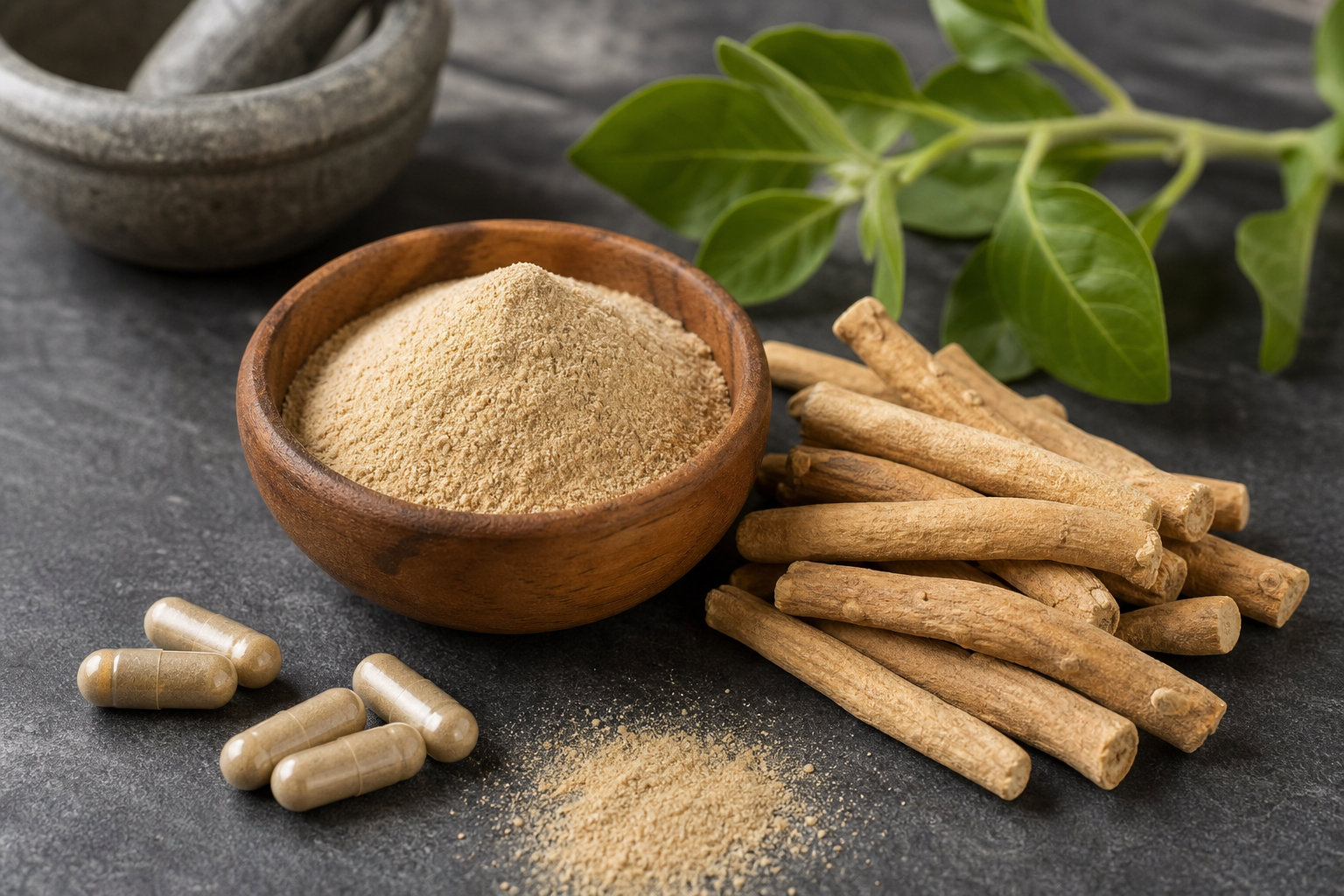
Withania somnifera figure parmi les composés botaniques les plus étudiés pour la résistance au stress et l'équilibre hormonal. Un essai de huit semaines impliquant des hommes pratiquant la musculation a révélé que 600 mg par jour d'extrait d'ashwagandha KSM-66 produisaient des augmentations de testostérone significativement plus élevées par rapport au placebo, parallèlement à des gains de force musculaire supérieurs et à une réduction de la graisse corporelle.
Les withanolides — les constituants actifs de la plante — exercent leur influence par le biais de multiples voies. Ils améliorent l'activité des enzymes antioxydantes dans le tissu testiculaire, protégeant les cellules de Leydig du stress oxydatif. La plante normalise également la fonction thyroïdienne, ce qui soutient indirectement un métabolisme sain de la testostérone. Les hommes subissant un stress chronique ou ayant des profils de cortisol élevés peuvent trouver l'ashwagandha particulièrement bénéfique dans le cadre d'un protocole de supplémentation complet.
Fenugrec : La graine légumineuse riche en saponines
Trigonella foenum-graecum contient des composés uniques appelés saponines furostanoliques qui démontrent des propriétés d'inhibition de l'aromatase. L'aromatase est l'enzyme qui convertit la testostérone en estradiol, et son activité excessive contribue au déclin de la testostérone lié à l'âge. Une étude de 2011 dans Phytotherapy Research a documenté que les hommes prenant 600 mg d'extrait spécialisé de fenugrec maintenaient des niveaux de testostérone libre significativement plus élevés que les témoins.
Au-delà de la modulation de l'aromatase, le fenugrec semble améliorer la sensibilité à l'insuline — un facteur métabolique intimement lié à la production de testostérone. La résistance à l'insuline est corrélée à des concentrations plus faibles de testostérone, créant une relation bidirectionnelle où l'amélioration du métabolisme du glucose soutient la santé hormonale. La familiarité culinaire du fenugrec en fait un point d'entrée accessible pour ceux qui découvrent les plantes soutenant la testostérone.
Extrait d'écorce de pin : Circulation stimulée par les proanthocyanidines
Bien qu'il ne stimule pas directement la synthèse de testostérone, le Pycnogenol (extrait d'écorce de pin maritime français) amplifie l'activité biologique de la testostérone existante par des mécanismes vasculaires. La recherche démontre qu'une production améliorée d'oxyde nitrique favorise le flux sanguin vers les tissus réceptifs aux androgènes, augmentant efficacement l'impact fonctionnel de la testostérone sans modifier les concentrations sériques.
Un essai clinique combinant l'extrait d'écorce de pin avec la L-arginine a montré des améliorations significatives des scores de fonction érectile et de satisfaction sexuelle rapportée. La teneur en proanthocyanidines offre une protection antioxydante puissante contre le peroxynitrite — une espèce réactive qui endommage les cellules endothéliales tapissant les vaisseaux sanguins. Pour les hommes cherchant à optimiser l'utilisation de la testostérone plutôt que simplement augmenter sa production, cette plante offre des avantages complémentaires.
Mucuna Pruriens : L-DOPA et signalisation dopaminergique
Cette légumineuse tropicale contient de la L-DOPA concentrée (lévodopa), un précurseur direct de la neurotransmission dopaminergique. Les voies dopaminergiques régulent la sécrétion de prolactine, et une prolactine élevée est inversement corrélée aux niveaux de testostérone. Une étude de 2011 impliquant des hommes infertiles a révélé que la supplémentation en Mucuna pruriens diminuait la prolactine tout en augmentant simultanément la testostérone, l'hormone lutéinisante et les paramètres spermatiques.
La connexion neurohormonale s'étend au-delà de la reproduction. La dopamine influence la motivation, le traitement de la récompense et les comportements orientés vers un but — des facteurs psychologiques qui soutiennent indirectement l'intensité de l'entraînement et les choix de vie favorables à l'optimisation de la testostérone. Les hommes éprouvant des déficits de motivation associés à des préoccupations hormonales peuvent trouver cette plante à double action particulièrement pertinente.
Bore : L'oligo-élément avec un levier hormonal
Bien qu'il s'agisse techniquement d'un minéral plutôt que d'une plante, le bore mérite d'être inclus pour son influence remarquable sur la biodisponibilité de la testostérone. Une étude pilote a révélé qu'une seule semaine de supplémentation en bore à raison de 10 mg par jour augmentait la testostérone libre de 28 % tout en réduisant l'estradiol de 39 %. Le mécanisme implique la modulation de la globuline liant les hormones sexuelles (SHBG), la protéine qui rend la testostérone biologiquement inactive lorsqu'elle est liée.
L'influence du bore s'étend aux marqueurs inflammatoires et au métabolisme de la vitamine D — deux facteurs ayant un impact sur la production de testostérone. Cet oligo-élément démontre comment le statut en micronutriments façonne fondamentalement l'équilibre hormonal, souvent négligé au profit de plantes plus exotiques. Les sources alimentaires incluent les amandes, les avocats et les fruits secs, bien que les formes supplémentées garantissent un apport constant.
Comment ces plantes se comparent-elles à la testostérone synthétique ?
Le traitement substitutif à la testostérone pharmaceutique arrête la production endogène par suppression par rétroaction négative. L'hypothalamus détecte l'augmentation de la testostérone circulante et cesse de signaler aux testicules de fabriquer leur propre réserve. Avec le temps, une atrophie testiculaire et une compromission permanente de la fertilité peuvent en résulter.
Les soutiens botaniques à la testostérone fonctionnent avec le mécanisme hormonal existant du corps plutôt que de le remplacer, préservant les boucles de rétroaction naturelles et la fonction testiculaire.
Cette distinction fondamentale explique pourquoi les consommateurs orientés vers la recherche se tournent vers les protocoles à base de plantes. Les améliorations progressives — généralement des augmentations de 15 à 40 % dans les essais cliniques — peuvent sembler modestes par rapport aux doses supraphysiologiques de TRT, mais elles préservent la capacité reproductrice et évitent l'arrêt de la production inhérent aux hormones exogènes.
Combinaisons synergiques et considérations d'absorption
Les composés isolés atteignent rarement l'efficacité des formulations soigneusement combinées. Certaines plantes traitent différents nœuds de la voie de production de la testostérone, créant des effets complémentaires. La réduction du cortisol par l'ashwagandha s'associe logiquement à la stimulation de l'hormone lutéinisante par le Tongkat Ali, tandis que l'inhibition de l'aromatase par le fenugrec protège la testostérone générée par les boosters en amont.
L'amélioration de l'absorption par la pipérine (extrait de poivre noir) ou des supports lipidiques améliore considérablement la biodisponibilité des composés phytochimiques liposolubles. Les tests par des tiers vérifient non seulement l'identité des ingrédients, mais aussi l'absence de contamination par des métaux lourds — une préoccupation majeure étant donné que de nombreuses plantes favorisant la testostérone proviennent de régions à la qualité de sol variable.
| Plante | Mécanisme principal | Dosage de recherche typique |
|---|---|---|
| Shilajit | Optimisation mitochondriale | 250-500 mg par jour |
| Tongkat Ali | Stimulation LH, réduction cortisol | 100-200 mg d'extrait |
| Ashwagandha | Adaptation au stress, antioxydant | 600 mg KSM-66 |
| Fenugrec | Inhibition de l'aromatase | 600 mg d'extrait standardisé |
Quels résultats pouvez-vous espérer de manière réaliste ?
Les réponses individuelles varient en fonction des niveaux de testostérone de base, de l'âge, des facteurs de style de vie et des polymorphismes génétiques affectant le métabolisme hormonal. Les hommes commençant avec une testostérone cliniquement basse (inférieure à 300 ng/dL) connaissent généralement des améliorations plus spectaculaires que ceux ayant des concentrations dans la moyenne.
Les délais sont très importants. La plupart des essais cliniques démontrent des changements mesurables après 8 à 12 semaines de supplémentation constante. Le corps a besoin de temps pour réguler les voies enzymatiques et restaurer une fonction optimale des cellules de Leydig après des années de déclin. Espérer des résultats rapides comparables à ceux des médicaments à partir d'interventions botaniques est irréaliste.
Les améliorations subjectives précèdent souvent la confirmation en laboratoire. Une énergie matinale accrue, une meilleure récupération entre les séances d'entraînement et une libido restaurée se manifestent fréquemment en 4 à 6 semaines, avant même que les niveaux de testostérone sérique atteignent de nouveaux points d'équilibre. Ces marqueurs expérientiels fournissent des retours précieux pour l'ajustement du protocole.
Les plantes booster de testostérone sont-elles sûres pour une utilisation à long terme ?
L'usage traditionnel s'étendant sur des siècles fournit des données de sécurité rassurantes pour la plupart des soutiens botaniques à la testostérone. Contrairement aux hormones synthétiques nécessitant une surveillance médicale et des contrôles sanguins réguliers, des plantes comme l'ashwagandha et le Tongkat Ali démontrent une tolérance remarquable dans diverses populations.
Cela dit, l'approvisionnement de qualité reste primordial. La contamination par des métaux lourds, des adultérants pharmaceutiques non divulgués ou des concentrations d'ingrédients actifs inconstantes affligent l'industrie des compléments. Les produits fabriqués dans des installations certifiées BPF (bonnes pratiques de fabrication) et portant des sceaux de vérification par des tiers réduisent considérablement ces risques.
Certaines personnes devraient faire preuve de prudence ou consulter des prestataires de soins de santé avant toute supplémentation :
- Hommes ayant des cancers hormonodépendants diagnostiqués
- Personnes prenant des médicaments métabolisés par les enzymes du cytochrome P450
- Ceux souffrant de troubles thyroïdiens (particulièrement avec l'ashwagandha)
- Toute personne présentant des symptômes inexpliqués justifiant une évaluation médicale
Intégrer les plantes booster de testostérone dans une stratégie globale
Aucune intervention botanique ne peut compenser le manque de sommeil, le stress chronique ou les carences nutritionnelles. L'optimisation de la testostérone nécessite une approche multidimensionnelle où la supplémentation amplifie — plutôt qu'elle ne remplace — les pratiques de base liées au mode de vie.
L'entraînement en résistance stimule la production de testostérone par le biais du stress mécanique exercé sur le tissu musculaire. Un apport adéquat en zinc et en magnésium soutient les conversions enzymatiques nécessaires à la synthèse hormonale. Une quantité suffisante de vitamine D agit comme précurseur d'hormone stéroïdienne. La composition corporelle a une importance capitale, car un excès d'adiposité augmente l'activité de l'aromatase et la dominance œstrogénique.
La supplémentation stratégique à base de plantes reconnues pour stimuler la testostérone constitue un élément de ce cadre plus vaste. Les hommes obtenant des résultats optimaux combinent généralement des plantes de qualité avec un entraînement en force progressif, des protocoles de gestion du stress, une optimisation du rythme circadien et des habitudes alimentaires riches en nutriments. Cette approche intégrative respecte la complexité du corps tout en tirant parti d'interventions spécifiques lorsque les preuves scientifiques soutiennent leur utilisation.