Shatavari Side Effects: 6 Myths and Facts for Women Over 45
Are there side effects of shatavari? Like any herb, shatavari can cause side effects in some people, but in recent clinical trials they were uncommon and mild. Most of the worry around shatavari comes from myths: that it is a hormone, that more is better, or that "natural" means nothing can happen. Here are six common myths about shatavari side effects, the facts behind them, and who should check with a doctor or pharmacist first.
Key Takeaways - Shatavari can cause side effects, like any herb. In recent placebo-controlled trials, reported side effects were few and mild. - Shatavari is a plant root, not a hormone. - More is not better: the studied dose is what counts. - Shatavari can be taken during menopause; most recent research was done in women in perimenopause and after menopause. - If you are pregnant or breastfeeding, take medication or have a hormone-sensitive condition, check with your doctor or pharmacist first.
Myth 1: "Natural means no side effects"
Fact: any herb can cause side effects, so it pays to know what has been reported.
"Natural" describes where something comes from, not how your body will react to it. The U.S. National Center for Complementary and Integrative Health has a good guide on using dietary supplements wisely, and its first message is simple: tell your health care providers about everything you take.
For shatavari, the best information comes from recent placebo-controlled trials. In an 8-week study of 135 women aged 45 to 65, only four participants reported mild side effects across all three groups: loose stools and dizziness in the shatavari-plus-ashwagandha group, nausea in the shatavari group, and a headache in the placebo group.
Myth 2: "Shatavari is a hormone"
Fact: shatavari is a plant root. It is not a hormone.
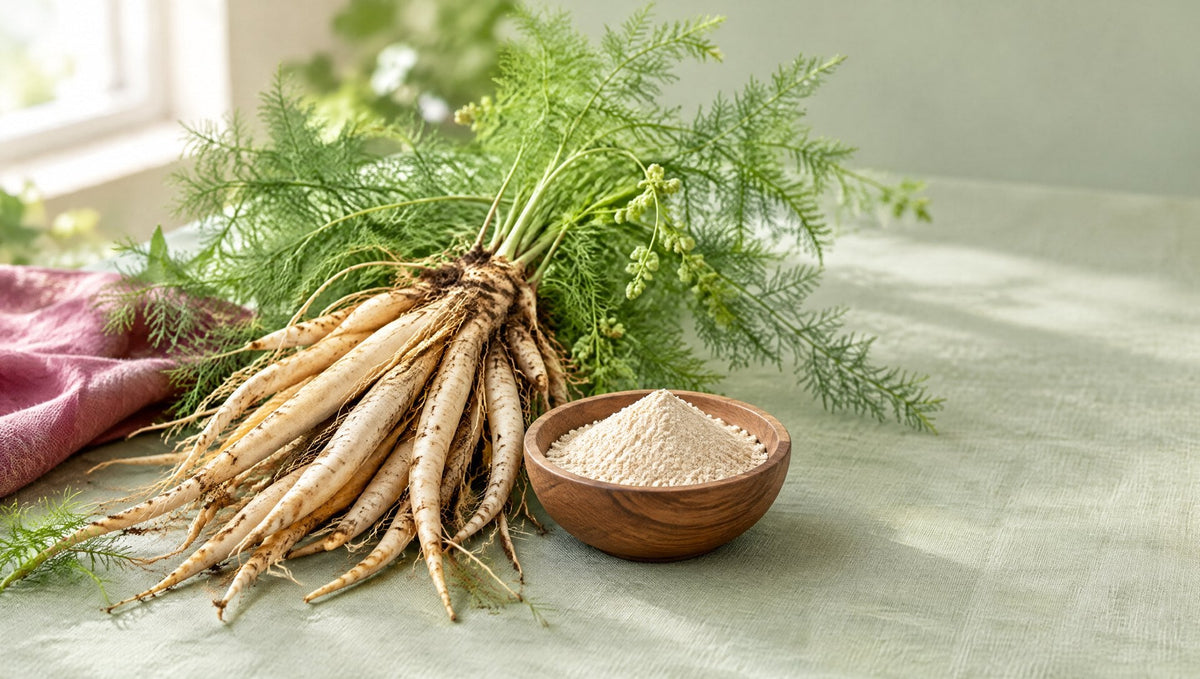
A 2025 review of the plant's chemistry describes shatavari roots as rich in natural compounds called steroidal saponins, known as shatavarins. Shatavarin IV is one of the best known. "Steroidal" describes the shape of the molecule; it does not make shatavari a hormone or hormone therapy.
In the 8-week study above, researchers checked hormone levels and liver, kidney and thyroid function at the end of the study, and reported that hormone levels stayed in the normal range.
Even so, if you have a hormone-sensitive condition or use hormone therapy, talk to your doctor before you start.
Myth 3: "If a little helps, more helps more"
Fact: the studied dose is the one to follow.
Doubling up does not double the benefit, and it can make an upset stomach more likely. Shatavari research uses specific extracts at specific doses. For our product, the research line is clear: 300 mg per capsule, the dose used in the published clinical studies on SRI-81™.
Follow your label for how many capsules to take and whether to take them with food. If you miss a day, just carry on the next day.
 A short daily note helps you spot both changes and any side effects.
Myth 4: "You can't take shatavari during menopause"
Fact: menopause is exactly where recent shatavari research has focused.
Can shatavari be taken during menopause? Yes. Several recent trials enrolled women during this stage. For example, one 8-week study followed 80 women with perimenopausal symptoms who took 300 mg of a shatavari root extract or a placebo once a day.
Menopause is not a single day. Mayo Clinic explains that symptoms often start in perimenopause, years before the final period, and many women still have them afterward. Shatavari can be part of your routine through each of these stages.
Myth 5: "If I feel a side effect, I should push through"
Fact: stop, and check with your doctor or pharmacist.
Mild stomach upset can happen with many supplements, and taking your capsule with a meal may help if your label allows it. But never ignore a reaction that worries you. Stop taking the product and get advice.
A simple tracking habit makes this easier. Each evening, note:
- Hot flashes and night sweats.
- Sleep and how rested you feel.
- Mood and energy.
- Anything new, such as stomach upset or headaches.
Start a few days before your first capsule, so you have a baseline. That way you can tell a real change from a normal bad week.
Myth 6: "All shatavari supplements are the same"
Fact: the form, standardization and quality checks differ a lot.
Some products are plain root powders with no stated level of active compounds. Others are standardized extracts. Before you buy, check:
- Standardization: a stated percentage of Shatavarin IV.
- The dose: the amount used in the published studies on that extract.
- The licence: an eight-digit NPN you can look up in Health Canada's Licensed Natural Health Products Database.
- Testing: third-party testing and a certified manufacturing facility.
 A cool, calm bedroom is one of the simplest habits for night-time comfort.
Who should check with a professional first?
Talk to your doctor or pharmacist before starting shatavari if you:
- are pregnant or breastfeeding;
- take any prescription medication;
- use hormone therapy or have a hormone-sensitive condition;
- have a health condition or are scheduled for surgery.
Always read the cautions on your product's label.
Our pick: a studied extract at the studied dose
Ultra Premium Shatavari with SRI-81™ uses SRI-81™, a root-only extract standardized to 5.8% Shatavarin IV, at 300 mg per capsule, the dose used in the published clinical studies on SRI-81™.

It is Health Canada licensed (NPN 80149608) and:
- Helps manage menopausal symptoms.
- Helps relieve vasomotor symptoms in perimenopausal women, such as hot flashes and night sweats.
- Helps reduce menopausal symptoms such as mild anxiety, irritability and fatigue.
- Helps support healthy sexual arousal and satisfaction in women.
It is made in a WHO-GMP certified facility, third-party tested (BSCG Drug-Free Certified), non-GMO, gluten-free and allergen-free.
Looking for more support at this stage of life? See our Ultra Premium Saffron with Affron®, or read natural mood supplement options for Canadian women and navigating menopause with inulin fibre.
Frequently asked questions
Are there any side effects of shatavari?
Shatavari can cause side effects, like any herb. In a recent 8-week placebo-controlled trial of 135 women, only four participants reported mild side effects, such as nausea, loose stools, dizziness or a headache, including one in the placebo group. Stop and ask your pharmacist if anything worries you.
Can shatavari be taken during menopause?
Yes. Recent shatavari research has focused on women in perimenopause and after menopause. Ultra Premium Shatavari with SRI-81™ helps manage menopausal symptoms. Check with your doctor first if you use hormone therapy or take medication.
Does shatavari contain hormones?
No. Shatavari is a plant root. Its roots contain natural compounds called shatavarins, a type of steroidal saponin. "Steroidal" describes the molecule's shape; it is not a hormone. Talk to your doctor if you have a hormone-sensitive condition.
Is it safe to take shatavari every day?
Shatavari is designed to be taken daily, as the label directs. Recent trials gave it daily for 8 to 24 weeks. Follow your label, don't take more than directed, and check with your doctor or pharmacist if you take medication.
The bottom line
Shatavari side effects are possible but, in recent trials, uncommon and mild. Most worries come from myths. Choose a standardized extract at the studied dose, follow the label, track how you feel and talk to your doctor or pharmacist if you take medication or have a health condition.
See miNATURALS Ultra Premium Shatavari with SRI-81™. Also on Amazon.ca.
This article is for information only and is not medical advice. If you take medication or have a health condition, check with your doctor or pharmacist before starting a supplement.