Shatavari vs Ashwagandha: 5 Differences to Know for Menopause
Shatavari vs ashwagandha: which one fits menopause? Both are roots from Ayurveda, and both show up on supplement shelves next to each other. But they come from different plants, contain different compounds and have been studied for different things. If menopause symptoms and low desire are your main concern, shatavari is the herb that has been studied most in women at this stage of life. This guide walks you through the differences, and whether you can take the two together.
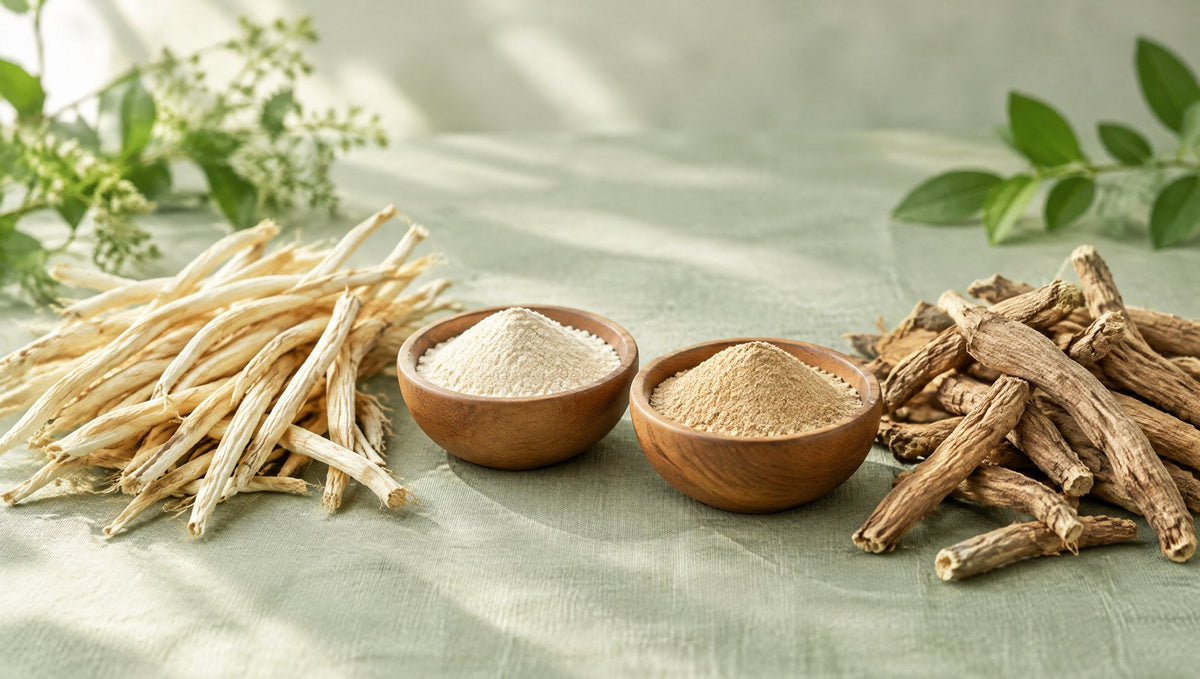
Shatavari (left) and ashwagandha (right): two roots, two very different plants.
Key Takeaways
- Shatavari (Asparagus racemosus) and ashwagandha (Withania somnifera) are different plants with different active compounds.
- Shatavari's roots contain natural saponins called shatavarins. Ashwagandha contains withanolides.
- Recent clinical research on shatavari has focused on women in perimenopause and after menopause. Ashwagandha research has focused mostly on stress and sleep.
- Researchers have studied the two together, but that does not make the pair right for everyone. Check with your doctor or pharmacist first.
- Whatever you choose, look for a standardized extract, the studied dose and an NPN.
Shatavari vs ashwagandha at a glance
| Shatavari | Ashwagandha | |
|---|---|---|
| Plant | Asparagus racemosus, a climbing asparagus | Withania somnifera, an evergreen shrub |
| Part used | Root | Root, leaf or both |
| Key compounds | Steroidal saponins (shatavarins, including Shatavarin IV) | Withanolides |
| Traditional role | A classic women's herb in Ayurveda | A rasayana herb, nicknamed "Indian ginseng" |
| Recent research focus | Women in perimenopause and after menopause | Stress and sleep |
What is shatavari?
Shatavari is a climbing plant in the asparagus family. Its long, pale roots are the part used in supplements. In Ayurveda it has a long history as a women's herb, and it is sometimes called the "Queen of Herbs".
A 2025 review of the plant's chemistry explains that shatavari roots are rich in steroidal saponins called shatavarins. Shatavarin IV is one of the best known. That matters when you shop: a good extract tells you how much of it is there.
In the last few years, researchers have run several placebo-controlled trials of shatavari root extract in women. For example, one 8-week study followed 80 women with perimenopausal symptoms who took 300 mg of a shatavari root extract or a placebo once a day.
What is ashwagandha?
Ashwagandha is a small evergreen shrub. According to the U.S. National Center for Complementary and Integrative Health (NCCIH), it grows in parts of India, Africa and the Middle East and contains compounds called withanolides.
NCCIH notes that ashwagandha supplements are mostly promoted for stress, anxiety and sleep. It also says there is not yet enough evidence to know whether ashwagandha helps with menopause. That is one of the clearest differences between the two herbs.
 Choosing the right herb starts with knowing what you want support for.
Which one fits your goal?
Start with the symptom that bothers you most, then match it to what each herb has been studied for.
- Hot flashes and night sweats: this is where shatavari research has focused. Our shatavari has an approved claim for it (see below).
- Mood swings, irritability and tiredness during menopause: again, shatavari is the herb studied in menopausal women.
- Low desire and intimacy: shatavari root extract has been studied in women for sexual wellness too.
- Everyday stress and sleep, outside of menopause: this is where most ashwagandha research sits.
If your main concern is menopause, shatavari is the more natural place to start. Ashwagandha is usually chosen for different reasons.
Can we take ashwagandha and shatavari together?
This is one of the most searched questions about the two herbs. The honest answer: researchers have started to study them together, but it is a decision to make with your doctor or pharmacist.
Two recent placebo-controlled trials looked at combinations:
- An 8-week study of 135 women aged 45 to 65 compared shatavari root extract alone, shatavari with ashwagandha root extract, and a placebo.
- A 24-week study of postmenopausal women aged 40 to 55 compared each herb on its own, the two combined, and a placebo.
These studies used their own extracts and doses, which may differ from what is in your bottle. They tell us scientists find the pairing worth studying. They do not tell you that the combination is right for you.
If you are thinking about taking both:
- Talk to your doctor or pharmacist first, especially if you take medication. NCCIH notes that ashwagandha may interact with some medicines and is not recommended for people with thyroid or autoimmune conditions.
- Start one at a time. If you start both on the same day, you can't tell which one you are reacting to.
- Follow each label for how much to take and when.
- Keep a short daily note on sleep, hot flashes, mood and energy, so you can see what changes.
 Read the label of every product you take, and bring the list to your pharmacist.
How to compare labels
Whichever herb you pick, the label tells you most of what you need to know:
- Standardization. Look for a stated amount of the active compound (for shatavari, Shatavarin IV; for ashwagandha, withanolides).
- The dose. Compare it with the dose used in the published studies on that extract.
- The part of the plant. Root-only extracts are the traditional choice for both herbs.
- An eight-digit NPN. Health Canada's Licensed Natural Health Products Database lets you look up any NPN and see the product's licensed claims.
- Third-party testing and a certified manufacturing facility.
Our pick for menopause support
Ultra Premium Shatavari with SRI-81™ uses SRI-81™, a root-only shatavari extract standardized to 5.8% Shatavarin IV. 300 mg per capsule, the dose used in the published clinical studies on SRI-81™.

It is Health Canada licensed (NPN 80149608) and:
- Helps manage menopausal symptoms.
- Helps relieve vasomotor symptoms in perimenopausal women, such as hot flashes and night sweats.
- Helps reduce menopausal symptoms such as mild anxiety, irritability and fatigue.
- Helps support healthy sexual arousal and satisfaction in women.
It is made in a WHO-GMP certified facility, third-party tested (BSCG Drug-Free Certified), non-GMO, gluten-free and allergen-free.
Curious about ashwagandha too? See our Ultra Premium Ashwagandha with Sensoril®, or read why we chose Sensoril® for our ashwagandha. For more on this stage of life, read mushroom complex benefits for women navigating perimenopause.
Frequently asked questions
Is shatavari the same as ashwagandha?
No. Shatavari (Asparagus racemosus) is a climbing asparagus, and ashwagandha (Withania somnifera) is an evergreen shrub. Both roots come from Ayurveda, but they contain different compounds: shatavarins in shatavari and withanolides in ashwagandha. Their research has also focused on different goals.
Which is better for menopause, shatavari or ashwagandha?
Recent clinical research on menopause has focused on shatavari, and NCCIH says there is not enough evidence yet to know whether ashwagandha helps with menopause. If menopause symptoms are your main concern, shatavari is the more natural place to start. Ask your doctor what fits you.
Can we take ashwagandha and shatavari together?
Researchers have studied the two together in women at midlife, but that does not make the pairing right for everyone. Check with your doctor or pharmacist first, especially if you take medication. Start one at a time and follow each label's directions.
What should I look for on a shatavari label?
Look for a root extract standardized to a stated amount of Shatavarin IV, the dose used in the published studies on that extract, an eight-digit NPN and third-party testing.
The bottom line
Shatavari and ashwagandha are both respected roots, but they are not interchangeable. For menopause, shatavari is the herb with the research focus. If you want to combine them, make it a conversation with your doctor or pharmacist, add one at a time and track how you feel.
See miNATURALS Ultra Premium Shatavari with SRI-81™. Also on Amazon.ca.
This article is for information only and is not medical advice. If you take medication or have a health condition, check with your doctor or pharmacist before starting a supplement.