Shatavari for Menopause: 5 Things to Know Before You Start
Is shatavari good for menopause? Shatavari is a traditional Ayurvedic root for women's health, and one standardized extract, SRI-81™, has been the subject of published clinical studies. If you are looking at shatavari for menopause, the form, the standardization and the dose matter more than the name on the front of the bottle. This guide walks you through what shatavari is, what the research looked at, and how to choose a product you can trust.
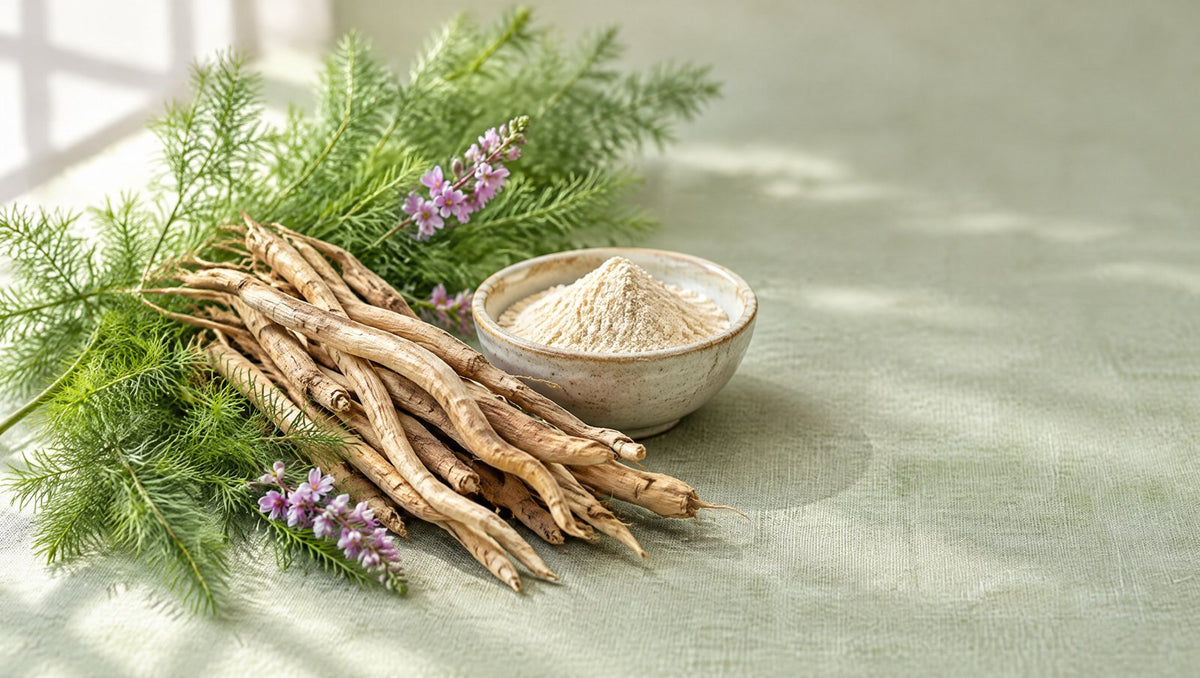
Shatavari root, the part of the plant used in Ayurveda and in SRI-81™.
Key Takeaways
- Shatavari (Asparagus racemosus) is a root with a long history of use in Ayurveda, especially in women's health.
- Menopause is confirmed after 12 months without a period; the years before it are called perimenopause.
- Not every shatavari supplement is the same. SRI-81™ is a root-only extract, and 300 mg per capsule is the dose used in the published clinical studies on SRI-81™.
- A licensed product carries an eight-digit NPN on the label, which means Health Canada has assessed it.
- If you take medication or have a health condition, check with your doctor or pharmacist first.
1. First, what is happening during menopause?
Menopause is not a single day. It is the point when periods have stopped for good. Mayo Clinic explains that menopause is diagnosed after 12 months without a menstrual period, and that it can happen in the 40s or 50s.
The years leading up to it are called perimenopause. According to Mayo Clinic's perimenopause overview, many women notice changes such as irregular periods sometime in their 40s. Some notice them as early as their 30s or as late as their 50s.
Common symptoms include:
- Hot flashes and night sweats
- Sleep problems
- Mood changes and irritability
- Vaginal dryness
- Trouble finding words or remembering ("brain fog")
Every woman's experience is different. Some barely notice the change. Others find that hot flashes, broken sleep and low energy affect work, relationships and intimacy. That is why so many women look for natural support alongside the advice of their doctor.
2. What is shatavari, and why is it linked to women's health?
Shatavari is the root of Asparagus racemosus, a climbing plant in the asparagus family. It grows in India and other parts of Asia. In Ayurveda, the traditional medicine of India, it has been used for centuries as a tonic for women at every stage of life.
The plant grows a cluster of long, tuberous roots, and those roots are the part that is used. Researchers have taken an interest in this traditional role too. A review in the scientific literature looked at stress and female reproductive health and the possible role of shatavari.
The root contains natural compounds called steroidal saponins. The best known are the shatavarins. One of them, Shatavarin IV, is used as a marker to standardize quality extracts, so each capsule delivers a consistent amount.
3. What does shatavari do for menopause? Here is what the research looked at
This is the question most women ask, and it deserves a careful answer. Shatavari products vary a lot. Some are generic root powders with no stated amount of active compounds. Others are standardized extracts, where the plant material, the extraction and the marker compounds are controlled.
SRI-81™ is one of those extracts. It is made from the root only and standardized to 5.8% Shatavarin IV. 300 mg per capsule is the dose used in the published clinical studies on SRI-81™. That detail matters. When a study uses a specific extract at a specific dose, you can only expect a product to match that research if it uses the same extract at the same dose.
Here is a simple way to compare what you may see on a shelf:
| What the label says | What it usually means |
|---|---|
| "Shatavari root powder" | Ground whole root; the amount of active compounds is not stated |
| "Shatavari extract 10:1" | A concentrated extract; the marker compounds may still not be stated |
| "Standardized to X% Shatavarin IV" | The extract is tested for a key marker compound |
| A named, studied extract (e.g. SRI-81™) at its studied dose | The form and dose match published clinical research |
4. "Natural" does not mean "anything goes"
A common myth is that a plant can't interact with anything. Shatavari is a food-based root with a long history of use, but a concentrated extract is still an active product.
Before starting any supplement during menopause, keep these points in mind:
- Talk to your doctor or pharmacist if you take medication, use hormone therapy, or have a hormone-sensitive condition.
- Read the label's cautions and warnings. A licensed product lists who should not take it and when to stop.
- Start with the label dose. More is not better. The studied dose is the one that matters.
- Give it time and keep notes. A short daily note on sleep, hot flashes and mood helps you and your doctor see what is changing.
5. How to check a shatavari supplement in 30 seconds
You don't need a science degree to choose well. Turn the bottle around and look for four things:
- An eight-digit NPN. Health Canada's Licensed Natural Health Products Database explains that you can identify licensed natural health products by looking for the eight-digit Natural Product Number (NPN) on the label. Products with a licence have been assessed by Health Canada.
- The plant part. "Root" is what Ayurveda and the clinical research use.
- Standardization. A stated percentage of Shatavarin IV tells you the extract is tested.
- The dose per capsule. Compare it with the dose used in the research on that extract.
 The extract name sits on the front of the bottle; turn it around for the NPN and the dose per capsule.
Why we chose SRI-81™ for miNATURALS Shatavari
When we built Ultra Premium Shatavari with SRI-81™, we wanted the form and the dose to match the published research, not just the name. Each capsule contains 300 mg of SRI-81™, the dose used in the published clinical studies on SRI-81™. It is a root-only extract standardized to 5.8% Shatavarin IV.

Ultra Premium Shatavari with SRI-81™ is Health Canada licensed (NPN 80149608). It:
- Helps manage menopausal symptoms.
- Helps relieve vasomotor symptoms in perimenopausal women, such as hot flashes and night sweats.
- Helps reduce menopausal symptoms such as mild anxiety, irritability and fatigue.
- Helps support healthy sexual arousal and satisfaction in women.
It is made in a WHO-GMP certified facility and is third-party tested (BSCG Drug-Free Certified). It is also non-GMO, gluten-free and allergen-free.
 Hot flashes and night sweats are among the most common signs of the change.
Many women also like to look at the rest of their routine during this stage. Our Ultra Premium Saffron with Affron® is another women's health favourite, and you can read more in our post on saffron health benefits every woman over 40 should know.
Frequently asked questions
Is shatavari good for menopause?
Shatavari is a traditional Ayurvedic root for women's health, and the standardized extract SRI-81™ has been the subject of published clinical studies. Ultra Premium Shatavari with SRI-81™ helps manage menopausal symptoms. Check with your doctor first if you take medication or use hormone therapy.
What does shatavari do for menopause?
Ultra Premium Shatavari with SRI-81™ helps relieve vasomotor symptoms in perimenopausal women, such as hot flashes and night sweats. It also helps reduce menopausal symptoms such as mild anxiety, irritability and fatigue. Results depend on the extract and dose, which is why the studied form matters.
Is shatavari the same as asparagus?
Shatavari is a cousin of the asparagus you eat. Both belong to the Asparagus genus, but shatavari (Asparagus racemosus) is grown for its roots, not its spears. The roots are what Ayurveda and the SRI-81™ research use.
How do I know a shatavari supplement is licensed in Canada?
Look for an eight-digit NPN on the label. Health Canada says the NPN identifies a licensed natural health product that it has assessed. You can also search the number in Health Canada's Licensed Natural Health Products Database.
The bottom line
Shatavari has a long history in women's health, and standardized extracts like SRI-81™ bring that tradition into published clinical research. If you want to try it, choose a licensed product with the studied extract at the studied dose, track how you feel, and keep your doctor in the loop. For more support through the change, read about mushroom complex benefits for women navigating perimenopause and vitamin D and mood.
See miNATURALS Ultra Premium Shatavari with SRI-81™. Also on Amazon.ca.
This article is for information only and is not medical advice. If you take medication or have a health condition, check with your doctor or pharmacist before starting a supplement.