

Menopause Supplements for Hot Flashes: 5 Research Facts
Which menopause supplements help with hot flashes? The honest answer is that it depends on the exact extract, the dose and the research behind one product, not on the word "natural" on the label. Hot flashes are one of the most common signs of the menopause transition, so the shelf is crowded with promises. This research summary walks you through what scientists have looked at, how to read it, and how shatavari fits in.
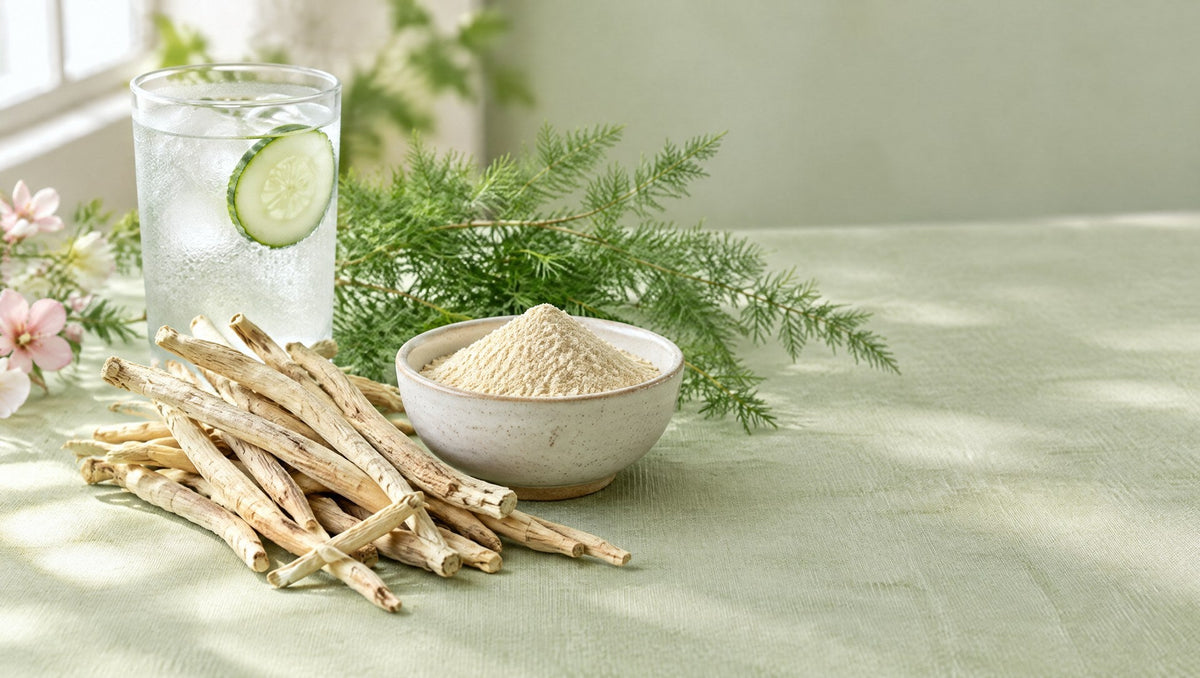
Shatavari root, one of the herbs researchers have studied in women around menopause.
Key Takeaways
- Hot flashes and night sweats (also called vasomotor symptoms) are common in perimenopause and menopause, and simple daily habits help.
- As a group, herbs and supplements have not been clearly shown to relieve menopause symptoms, so look at the evidence for the specific extract.
- Several recent placebo-controlled trials have studied standardized shatavari root extracts in women around menopause. Each used its own extract and dose.
- SRI-81™ is a root-only shatavari extract, and 300 mg per capsule is the dose used in the published clinical studies on SRI-81™.
- If you take medication or use hormone therapy, check with your doctor or pharmacist before starting a supplement.
1. What is a hot flash, and why does it happen?
A hot flash is a sudden feeling of warmth that spreads over the upper body. Mayo Clinic describes flushing, sweating and a fast heartbeat, sometimes followed by a chill as the heat fades. When it happens at night, it is called a night sweat.
Doctors link hot flashes to the hormone changes of the menopause transition. As estrogen levels shift, the body's internal thermostat seems to become more sensitive to small changes in temperature. The result is a burst of heat that the body then works to release.
Hot flashes vary a lot from woman to woman. Some women have a few mild ones. Others have frequent, intense episodes that disturb sleep, work and mood for years. That is why many women look for support alongside their doctor's advice.
2. What does the research say about menopause supplements as a group?
The short answer: the evidence is uneven. The U.S. National Center for Complementary and Integrative Health (NCCIH) says that phytoestrogens, herbs and other dietary supplements have not been clearly shown to relieve menopause symptoms as a group.
That statement is about categories, not single products. A category such as "herbs for menopause" mixes very different plants, parts, extracts and doses. When studies of different products are pooled, the strong and the weak cancel each other out.
Black cohosh is a good example. It is one of the best-known herbs for hot flashes, yet NCCIH notes that studies of black cohosh for menopause symptoms have had mixed results, and that liver problems have been reported in some people who took it. Being popular is not the same as being well supported.
So the useful question is not "do menopause supplements work?" It is "what has this exact extract, at this dose, been studied for?"
3. How do researchers test a supplement for hot flashes?
The most reliable design is the randomized, double-blind, placebo-controlled trial. Here is what each part means:
| Term | What it means | Why it matters |
|---|---|---|
| Randomized | Women are assigned to groups by chance | The groups start out alike |
| Double-blind | Neither the women nor the researchers know who takes what | Expectations can't colour the results |
| Placebo-controlled | One group takes an identical-looking capsule with no active ingredient | Hot flashes often ease on their own over time, so a fair comparison is needed |
| Standardized extract | Each capsule holds a tested amount of a marker compound | Another product can only match the study if it uses the same extract and dose |
Researchers usually ask women to keep symptom diaries and fill in menopause questionnaires at the start and at set points during the study. That lets them compare changes between groups rather than relying on how anyone remembers feeling.
4. How does shatavari help menopause? What has been studied
Shatavari is the root of Asparagus racemosus, a climbing plant used in Ayurveda as a women's tonic for centuries. The root contains natural compounds called steroidal saponins, including the shatavarins. Exactly how shatavari works in the body is still being studied.
What has changed in recent years is the quality of the research. Several randomized, double-blind, placebo-controlled trials have looked at standardized shatavari root extracts in women around menopause, with hot flashes and night sweats among the symptoms measured. Examples include a trial in perimenopausal women, a three-arm study on menopausal symptoms and a multicentre randomized trial.
Two points matter when you read studies like these:
- Each trial used its own extract and its own dose. Its findings belong to that extract. They do not carry over to a generic root powder or to a different brand.
- The details on the label are what connect a product to a study. Look for the extract name, the plant part, the standardization and the amount per capsule.
 A short daily note on hot flashes, sleep and mood helps you and your doctor see what is changing.
5. What else helps with hot flashes day to day?
A supplement works best as one part of a routine. The U.S. National Institute on Aging suggests a few simple steps:
- Track your triggers. Hot drinks, caffeine, alcohol, spicy food, stress and warm rooms are common ones. A two-week note often shows a pattern.
- Dress in layers. Choose clothes you can remove quickly, in breathable fabrics.
- Keep cool water close. Sip it when a flash starts.
- Cool the bedroom. A fan, light cotton bedding and a slightly open window can make nights easier.
- Try slow, deep breathing. It can help you stay calm while a flash passes.
Regular movement helps too. NCCIH notes that yoga seems to be at least as effective as other types of exercise for menopause symptoms, so choose the activity you enjoy and will keep doing.
 Light layers and a daily walk: two easy habits for the hot-flash years.
Why we chose SRI-81™ for miNATURALS Shatavari
We built Ultra Premium Shatavari with SRI-81™ around a named, standardized extract instead of a generic powder. SRI-81™ is a root-only extract standardized to 5.8% Shatavarin IV. 300 mg per capsule is the dose used in the published clinical studies on SRI-81™.

Ultra Premium Shatavari with SRI-81™ is licensed by Health Canada (NPN 80149608). It:
- Helps relieve vasomotor symptoms in perimenopausal women, such as hot flashes and night sweats.
- Helps manage menopausal symptoms.
- Helps reduce menopausal symptoms such as mild anxiety, irritability and fatigue.
It is made in a WHO-GMP certified facility and is third-party tested (BSCG Drug-Free Certified). It is also non-GMO, gluten-free and allergen-free. You can check any licensed product yourself in Health Canada's Licensed Natural Health Products Database by its eight-digit NPN.
Many women also look at mood and energy during these years. Our Ultra Premium Saffron with Affron® is another women's health favourite. You can read more in saffron health benefits every woman over 40 should know and in our guide to mushroom complex benefits for women navigating perimenopause.
Frequently asked questions
Are there menopause supplements for hot flashes that are backed by research?
Some specific extracts have been studied in placebo-controlled trials, but supplements as a category have not been clearly shown to relieve menopause symptoms. Look for a named, standardized extract at the dose used in its studies, and a Health Canada NPN on the label.
How does shatavari help menopause?
Researchers are still studying how shatavari works. The root contains steroidal saponins called shatavarins. Ultra Premium Shatavari with SRI-81™ helps relieve vasomotor symptoms in perimenopausal women, such as hot flashes and night sweats, and helps manage menopausal symptoms.
Is black cohosh the same as shatavari?
No. Black cohosh is a North American plant, while shatavari is the root of Asparagus racemosus from India and tropical Asia. They contain different compounds and have different research. NCCIH reports mixed results for black cohosh and some reports of liver problems.
Can I take a supplement for hot flashes with hormone therapy?
Ask your doctor or pharmacist first. They know your health history and your other medicines, and they can tell you whether a natural health product fits your plan. Bring the bottle or the NPN to the appointment.
The bottom line
Hot flashes are common, and you have more options than "put up with it". Start with the daily habits that cool things down, keep a short symptom note, and judge any supplement by its exact extract, its dose and its licence. If shatavari interests you, see miNATURALS Ultra Premium Shatavari with SRI-81™. It is also on Amazon.ca.
This article is for information only and is not medical advice. If you take medication or have a health condition, check with your doctor or pharmacist before starting a supplement.